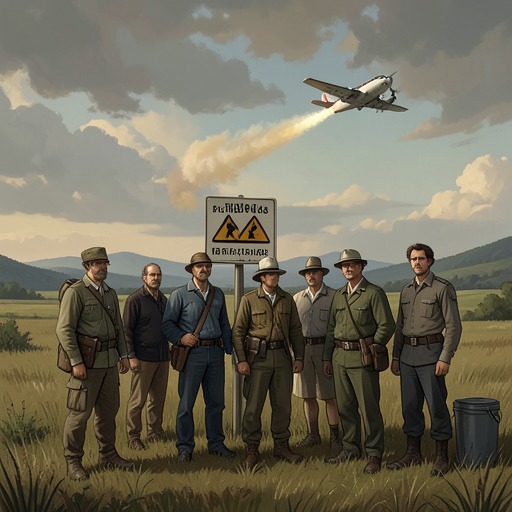
Warbler
Silent SpringWarblers are migratory treetop-feeding birds whose spring passage through wooded landscapes becomes a measure of the harm caused by insecticide spraying. The account links their disappearance from heavily sprayed areas to two connected pressures: exposure to poisoned insects and the loss of food. When a late spring aligned elm spraying with an exceptionally heavy migration, nearly every warbler species in the area was represented in the ensuing kill. At Whitefish Bay, Wisconsin, a former count of at least a thousand Myrtle warblers during migration had fallen to two in 1958 after the elms were sprayed.
Habitat and Migration
Warblers glean insects from leaves in the treetops, placing them among the birds directly exposed when foliage is sprayed. Their vulnerability is not limited to a single local population or season: the account describes migrating flocks passing through the trees in spring as a broad wave of life. In heavily sprayed areas, treetop-feeding birds had disappeared, and warblers were among the affected groups.
The timing of the spraying mattered. In 1956, a late spring delayed the work until it coincided with the arrival of an exceptionally heavy wave of migrating warblers. The overlap brought a large number of birds into the affected area at the moment the trees were being treated, turning a routine control operation into a mass exposure across many species.
The Spraying and Its Effects
Nearly all warbler species present in the area were represented in the heavy kill that followed the 1956 spraying. The account names a wide range of losses, including Black-and-white, Yellow, Magnolia, and Cape May warblers, as well as Ovenbirds, Blackburnian, Chestnut-sided, Canadian, and Black-throated Green warblers. The breadth of this list shows that the impact was not confined to one kind of warbler or one narrow feeding niche within the treetops.
The birds faced more than one route of harm. They could be affected directly by eating poisoned insects, or indirectly when spraying reduced the insects available as food. That distinction matters: the damage extended beyond birds that ingested contaminated prey, because a disrupted food supply also threatened treetop feeders. In the account, disappearance and mortality are tied both to chemical exposure and to the loss of the living resources on which these birds depended.
A Measure of Decline
Whitefish Bay, Wisconsin, gives the change a concrete scale. In former years, observers could see at least a thousand Myrtle warblers migrating through the area. In 1958, after the elm spraying, they could find only two. The comparison is not simply a change in a species list: it sets a remembered abundance against a near absence in the same migratory context.
The account adds the Whitefish Bay observation to reports from other communities, extending the record beyond a single locality. The warblers’ decline thus appears within a wider pattern of losses associated with elm spraying, while the unusually heavy migration of 1956 and the later count at Whitefish Bay make the pattern legible through both a specific collision in time and a stark local comparison.
Significance in the Book
The warblers’ spring movement gives the account a way to connect a local management decision with effects that travel through a landscape. The birds arrive as part of a migration that crosses wooded areas; spraying aimed at the elms reaches them through the insects they eat and through the food supply it diminishes. Their fate therefore cannot be separated from the condition of the trees and the smaller life inhabiting their leaves.
By naming individual kinds of warblers and setting the Whitefish Bay count beside the broader kill, the account makes ecological damage specific without treating it as an isolated accident. The central contrast is between a regular migration once observed in great numbers and a landscape where spraying coincides with, and contributes to, widespread loss. Warblers function as both affected animals and evidence of how chemical control can unsettle relationships within a wooded habitat.